Fab shop
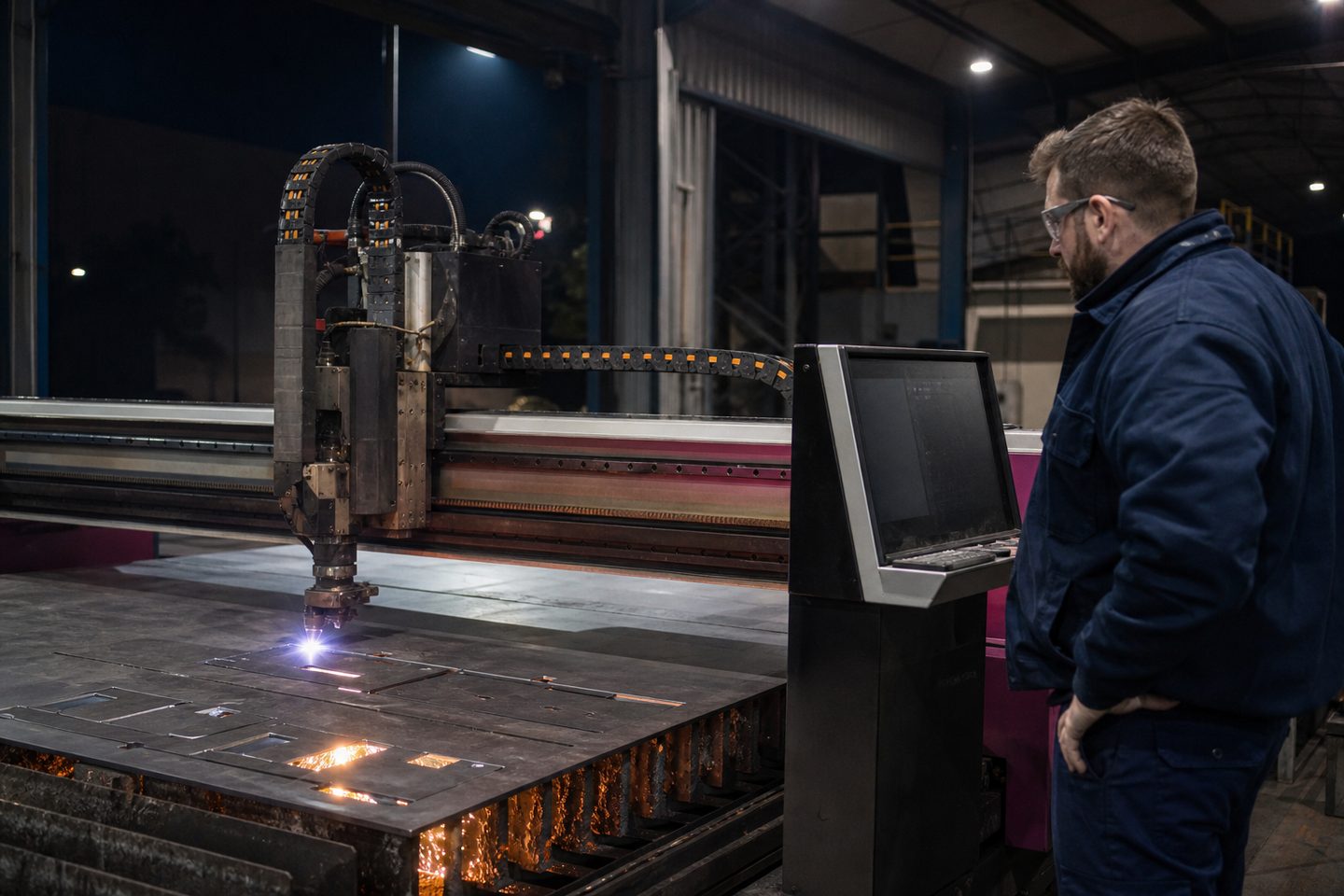
Running a plasma table overnight helped this Germiston fab shop deliver urgent jobs on time, even with power cuts and a tight local market.
In Germiston’s industrial strip, one fabrication shop struggled to keep big projects moving with only a single daytime shift. With production squeezed by daytime power cuts and customers calling for quicker turnarounds, management needed a way to fill the order book without burning out the day crew.
They knew the risks of late-night work: lower supervision, more mistakes if changeover isn’t handled right, and extra wear on machines. Still, the only way to hit target volumes was to run their plasma bay through the night, with a separate shift taking over after hours.
We recommended our Feature Plasma Compact, a table sized for typical sheet work in Gauteng, with torch height control and a simple interface that could be handed over safely between shifts. The key was to make the night handover foolproof: the day team set the pierce and cut heights, cleaned out the fume tray, and clamped down mild steel sheets for the night.
Operators logged settings and marked the work zero position, then locked the torch height and left a labelled collet tray with backup consumables. We fitted the air supply with an inline dryer to cut down on nozzle fouling from condensation, as plasma consumable life is especially sensitive to water in the line under overnight humidity.
Within three weeks, the night crew settled into a rhythm: clearing scheduled jobs with fewer stoppages, since all programming and fixturing was done by the day team. Scrap dropped as operators worked from a known baseline every night. The biggest early hurdle was power cuts after midnight, which left jobs half-finished.
We added a UPS to the CNC controller and trained the night shift on safe shutdown and re-homing axes, so work zero could be rechecked after power returned. Service intervals were shortened as airborne dust built up faster at night, especially in Germiston’s dry air. With the Feature Dust Cell running, cleaning time dropped, and filter packs were swapped more often.
Night plasma shifts can boost throughput for shops with steady, repeatable runs, but routine only works if handovers are tight and consumables are stocked. Use torch height locks, log all settings, and keep a clear record for each shift.
Add a UPS to protect against local power cuts and train all operators on safe recovery. In towns like Joburg or Germiston, check fume extraction is working, as night cutting can build up more dust under still air. Secure the bay, check PPE and hearing protection, and keep an eye on maintenance as twice-daily shifts raise wear on rails, bearings and filters.
Verified Google reviews